Massachusetts Digital Treasures

Image

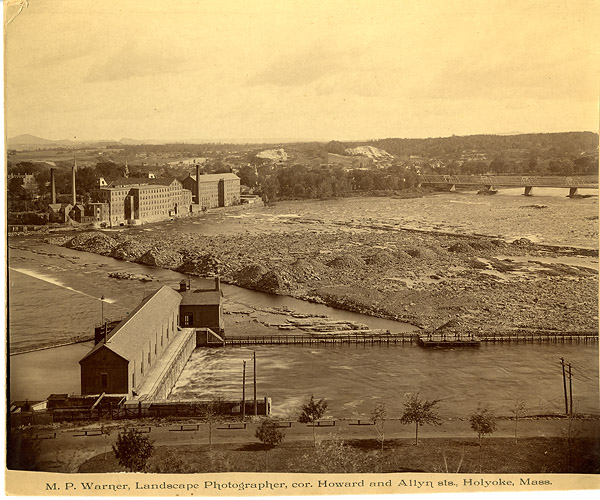
(South Hadley view from Holyoke: 1894 – Photo courtesy of MA Digital Treasures) 

The Digital Public Library of America (DPLA) brings together libraries, archives, and museums around the country through a massive digital archive system. These archives are available to anyone with internet access. It’s a resource that provides books, images, historical records, and audiovisual materials. Conceptualized in 2010, the creation of the DPLA took two years.

Similar to the DPLA, we here in Massachusetts have  a more local source for archival history and digital resources: The Massachusetts Digital Treasures Project. The project was a collaborative effort made by the Central and Western MA Automated Resource Sharing System, and the Central and Western MA Regional Library Systems. Initiated in 2006, it began as a pilot program with a headquarters in Worcester. Massachusetts Digital Tresures now has 36 collections from MA libraries with over 1,300 accessible images.

Browsing the Massachusetts Digital Treasures library gives us all an opportunity to take a look back at and learn about the local history of this state. Through the many photographs available, we are able to see the incredible ways in which places change with the passing of time. This digital library project continues as a collaborative effort among the MA library systems to bring funding, guidance, and expertise to the archives.

mt holyoke summit hous ma digital archives


(Mt. Holyoke Summit House, North Side – Photo courtesy of MA Digital Treasures)

South Hadley’s 150th Anniversary

Image

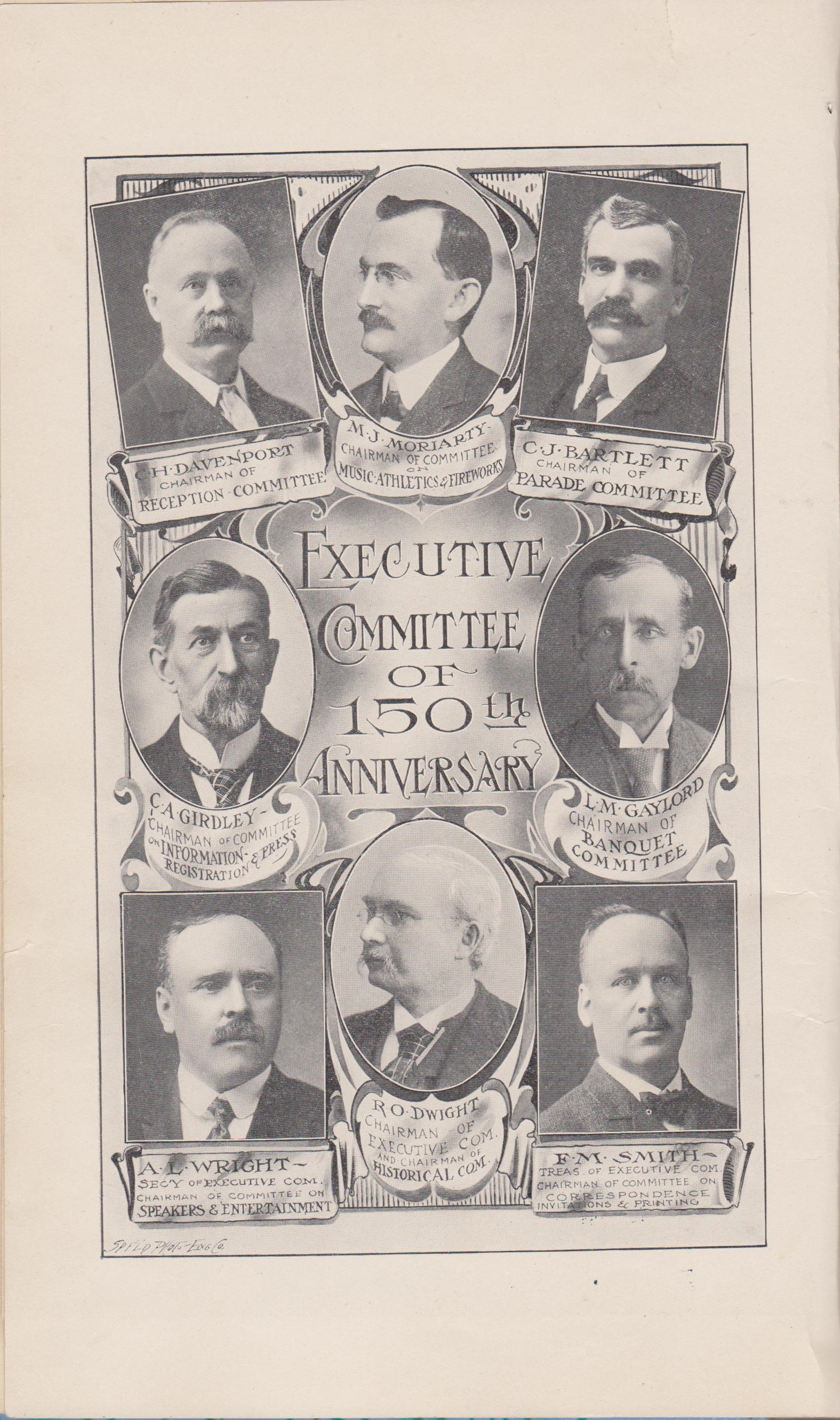
(Photo taken from Sesqui-Centennial Anniversary Celebration of the Town of South Hadley, Massachusetts. The center right photograph is of Lewis M. Gaylord.)

In keeping with my last post, today I’ll tell you about another South Hadley celebration: the 150th anniversary. South Hadley’s actual 150th anniversary was on April 12, 1903, but that year it was decided to hold the celebration during Old Home Week at the end of July instead, in order to allow time to prepare. At a special Town Meeting in January, they had appointed a committee to tell them whether or not holding a celebration was a good idea. The committee reported back to them at the regular Town Meeting on March 16, so using the actual anniversary would have resulted in having slightly less than a month to organize the entire party. The celebration was put off to the Wednesday and Thursday of Old Home Week, July 29 and 30, 1903.

The planning of the celebration involved several members of the Gaylord family. Henry E. Gaylord was on the Committee on Speakers and Entertainments, Lewis M. Gaylord chaired the Banquet Committee on which Clara N. Gaylord sat, Elizabeth Gaylord sat on the Historical Collections Committee, and Frances C. Gaylord sat on both the Reception Committee and the Committee on Publication. No other family had as many members involved with the various planning committees. (As the library was opened only a year later, construction must have been underway at the time, so they were active in this planning while their family was also building this library.)

The celebration was divided into one day for speech-making, toasts, and church exercises, and another day for less formal entertainments such as a parade and a ball game. The town elected to invite “Mother Hadley, Sister Amherst, and Daughter Granby” to join in the festivities, and throughout the chronicle of events there are frequent references to the close relationship between South Hadley and those three towns.

July 29th dawned humid and gray, although the rain did not fall until the afternoon. Since this was the day of indoor solemnity, the rain didn’t matter very much, although I imagine sitting in a crowded church on a warm, humid day was not the most comfortable. The morning involved prayers, speeches, poetry readings, and the singing of hymns. The speeches were largely in praise of the town’s history and its status in the speakers’ eyes as the quintessential perfect American town. Everybody then went to partake of the banquet, during which there were so many toasts of such length that it came time for the afternoon band concert to begin before they had finished all of them, and some had to be postponed to the evening reception.

July 30th featured a concert by Colt’s Armory Band, followed by a “floral parade” which consisted of horse-drawn floats bedecked with flowers and bunting. Mrs. Henry E. Gaylord and Miss Gertrude Gaylord rode in the parade in a carriage bedecked with yellow roses. After the parade, the fire departments of South Hadley Falls, Chicopee Falls, and Holyoke competed to see who could shoot a stream of water the highest into the air, and South Hadley falls exhited an antique fire engine. This was followed by yet more speeches, as well as a telegram from Chu Pau Fay, who had been educated in South Hadley before going to teach in China.

This was followed with a ball game and, as there have always been on the Fourth of July, many fireworks to end the night.

(Information comes from Sesqui-Centennial Anniversary Celebration of the Town of South Hadley, which was published by the town in 1906 in commemoration of the 1903 anniversary.)

Fourth of July Through the Years

Image

(Photo Courtesy of Dale Johnston)

The Fourth of July celebrations this year included not only the traditional fireworks, but also popcorn, face painting, a trampoline, fried dough, and musical performances, all put on at the Michael E. Smith Middle School on the evening of the third. The excitement attracted a sufficient crowd of people for the enthusiastic applause and cheering after the fireworks to be heard several streets away.

This exuberant celebration has a long history in South Hadley, although it was not always tradition: Sophie Eastman, in her book Old South Hadley, briefly decries the “noisy demonstrations” the holiday had fallen to and tells us how the day was originally celebrated with sermons and patriotic songs intended to remind everyone about the heroism and suffering of the soldiers in the Revolutionary War, which were then followed by a good dinner for the town. Accounts differ as to whether the holiday was first celebrated in South Hadley in 1776 when the Declaration was signed or 1783 when it became a national holiday—it didn’t become a legal holiday until 1941.

By 1882 the sermons had fallen by the wayside and the celebrations were done by local organizations rather than by the town. The festivities that year included a parade, a concert, a ball game, and a dance as well as the ever-present fireworks. Eastman was right to consider the celebrations noisy—while the particular elements of the festivities changed from year to year, they were always loud and always included fireworks. Irene Cronin recounts an anecdote whereby the fireworks were even used as a demolition tool. A clothing company had posted a sign which was locally reviled on an island in the river and refused to remove it. Some local boys took blasting powder, kerosene, and a long fuse and placed them underneath the sign late at night on July third, which they then lit the morning of the fourth, destroying the sign. Although a $100 reward was posted for information leading to their arrest, they were never caught.

While this incident did not lead to any damage or loss of life, there were other incidents with fireworks that did, and Massachusetts eventually banned the sale of fireworks. Instead of everyone shooting off fireworks every which way, firework displays by professionals became common, as we had here the night of the third. While our other amusements have again changed—I can’t recall the last time I heard of a celebratory game of quoits as part of a Fourth of July celebration—we still have the fireworks.

(Irene Cronin recounted her story in the 1993 Hampshire Weekend Gazette in the article “Feting the 4th in the Past.”)

Sophie Eastman–A Historian and a Mystery

It is very, very difficult to find any information regarding the life of Sophie Eastman. Her manuscript, published in 1912 and popular in certain historical circles, is about the only glimpse we have into her rich and varied life experiences. “In Old South Hadley (MA)” is a well written and succinct account of South Hadley history from its founding up until the mid eighteen hundreds. The 334 page history is a careful study of both broad and sweeping historical events as well as minuscule details of daily life right down to dish washing methods and the installation of drinking pumps in the center of town. Beautiful photographs taken by Eastman herself and copies of illustrations by artists in South Hadley accompany the text. I suggest setting aside an entire afternoon if you plan on reading her fascinating portal into life in Old South Hadley. The manuscript is descriptive, full of incredible detail, and quite exhaustively researched. From the founding of South Hadley before the Revolutionary War to the early days of Mt. Holyoke College to Thanksgiving Day traditions “In Old South Hadley (MA)” is well worth the time spent. Eastman’s literary tone lends a personal nature to her work in that she weaves historical fact with personal narrative and quirky stories about past residents of the town.

But who is Sophie Eastman? That is a more difficult question to answer. Her biographical facts are well known: daughter of prominent merchant Charles Eastman and sister to George and Julie Eastman. Born 1839 and died in the early 20th century. Educated at Wheaton College and professor at Mt. Holyoke College when it was still a seminary for young women. She is also known for her poem written in celebration of the South Hadley sesqui-centennial as well as a 17 page work entitled “The Early Days of Mt. Holyoke College.” She insisted on starting and ending her classes on the Mt. Holyoke with a prayer and was a permanent fixture on campus throughout her life. Not much else is known about Sophie Eastman. The categorical silence about her personal life serves to spark curiosity rather than dampen it. What was her personal life like? Did she carry on a romance with anyone? What were her feelings on marriage and women’s rights? Why did she feel it was important to record the history of her town? What did she teach at Mt. Holyoke College?

It is a little sad, actually, that we do not know more about this amazing woman who has played such a large part in recording South Hadley’s history. Much about her can be inferred from what we do know. The fact that she was college educated and went on to teach at Mt. Holyoke College during a time when women had to fight for the right to graduate high school speaks volumes about her strength of character and commitment to education. Her involvement in the seminal days of Mt. Holyoke gives us a picture of a strong and pioneering woman. The accomplishments in historical recording let us know that she had a strong passion for history and the importance of recording the past for future generations.

What we do know about Sophie Eastman is that she produced an amazingly interesting and accurate historical representation of life in South Hadley before the turn of the twentieth century. Her manuscript serves to both inform and entertain readers and her incisive commentary gives us a small picture of her opinions and world view. The text is available for perusal in the Gaylord Library collection.

An online copy of the text can be found here: http://openlibrary.org/books/OL13524070M/In_o_ld_South_Hadley

Enjoy!

This is the House that Jack Built

If you have ever walked down Woodbridge Street in South Hadley, you may have noticed a peculiar inscription on the chimney of one of the houses stating, “This is the House that Jack Built.” This “house that Jack built” is the Croysdale Inn located at 21 Woodbridge Street.

The inn was built by John (Jack) Parfitt, a Holyoke builder, in the spring of 1911. “Jack” constructed the inn for his two sisters, Frances and Isabella, so that they could expand their business, Ye Old English Tea Rooms. The sisters began their business in the spring of 1909 in a small red building located near the village common. The business quickly became popular, especially with the Mount Holyoke College girls. In need of more space, the sisters moved the tea rooms into a nearby house just a year later, which shortly proved unable to accommodate the increasing business. The following spring, their brother constructed the spacious Croysdale Inn (named after a family ancestor) so that the tea rooms could expand.

Upon the completion of the Croysdale Inn, the many people who helped plan and construct the inn decided to engrave on the north chimney, “This is the House that Jack Built” to capture the heart and effort put in to its establishment. Whether coincidence or not, I cannot help but think that the inscription also serves as a nod to the popular British nursery rhyme by the same name. Regardless of who or what the dedication was truly meant to honor, the inn has become best known by those words rather than by its given name.

The substantial three story building originally had a gray colored stucco exterior with dark green trimmings. The first floor, decorated in gold and brown was comprised of four dining rooms, a large kitchen, and a wide piazza at the back which was used to serve afternoon tea. The three smaller dining rooms were called the English, Dutch, and Japanese rooms, and they were designed to accommodate small parties. The north dining room ran the length of the building and was used for larger parties. According to Irene Cronin, who had written a piece on the building in the Hampshire Weekend Gazette in 1995, “The inn catered to parties, private lunches, and dinners and was noted for its home cooking.” Frances and Isabella not only ran their business on the first floor of the inn, but they lived upstairs in one of the many bedrooms on the second and third floors.

The sisters operated the tea room for 18 years until they decided to close the business and divide the building into apartments. They remained in the house for a few more years while Frances worked at Mount Holyoke College as secretary to the treasurer. In 1937 they turned the house over to the Home Owners Loan Corp. The property then went through several owners until it was purchased and renovated by Mount Holyoke College in 1959.

Today, the apartments continue to house faculty of Mount Holyoke College.

Like the nursery rhyme that tells a cumulative tale of people and things indirectly related to the house of a man named Jack, “The House that Jack Built” has a long history in South Hadley that undoubtedly will continue to grow.

Croysdale Inn. If you look closely, you can see the dedication on the chimney, "This is the House that Jack Built."

Special thanks to Irene Cronin for her information on the building through her article “Inn was ‘the house that Jack built’” published in the Hampshire Weekend Gazette 1995.