“The Proprietors of the Locks and Canals on Connecticut River”

The Inclined Plane Canal of South Hadley seems to be in the air at the moment. Last Thursday, the Library began offering plaques for sale which feature the canal and the words “Welcome to South Hadley.” (For those interested, the painted commemorative plaques are available for $20, $2 of which directly benefits Gaylord Memorial Library.) Indubitably inspired by the plaque, a patron also brought up the canal in a conversation last Friday. Finally, this Tuesday, I heard it mentioned in my biology class, in tangential connection to geology, Darwin, and monetary profit. As a non-resident of South Hadley and firmly cloistered in my studies, I had not the slightest idea of what an “inclined plane canal” entailed, much less what one was doing in South Hadley.

According to Alice Morehouse Walker, whose knowledge of Hadley truly is amazing, the inclined plane canal began construction in 1792 (1906: 109). The impetus for such an endeavor was a company, “The Proprietors of the Locks and Canals on the Connecticut River.” At the time, the Connecticut River facilitated transportation considerably (more articles to follow regarding the River). As Walker writes, “this natural waterway formed a connecting link between the isolated villages by means of which they were kept in touch with each other and in communication with the outside world” (1906: 109). Lumber was rafted down river, in addition to “farm produce, shingles, ash plank, furs and fish” (Walker, 1906: 107). Once downstream, the rafts and boats had to be poled up stream. “Poling was the hardest work known and caused much lameness and blistering of the skin in front of the shoulder, for which a frequent application of rum was a remedy” (Walker, 1906: 108). Furthermore, in South Hadley, “The Connecticut River had a fall of about fifty-three feet in the two and one half miles of rapids” (Taugher, 5). An inclined plane canal, in this context, is justifiable.

Building the canal was a daunting task, and back then, no canal had ever been built in the United States. “Gun powder was the only explosive known and drilling was done by the hands of man” (Walker, 1906: 109). The channel for the canal went through solid rock for two and a half miles and at its narrowest, was 20 feet wide (Walker, 1906: 109; Taugher, 4-5). Dutch enterprisers, who would certainly profit from increased commerce as well as the anticipated tolls, supplied the majority of the funding, but money was apparently scarce at the time (Taugher, 4). In addition, because of the drilling, water flooded nearby fields and meadows, “produced fever and ague, and indignant citizens clamored for the removal of the time [while] Those interested in the fisheries demanded a fishway that the shad might go up the river to their spawning shoals” (Walker, 1906: 109).

Furthermore, the mechanics of an inclined plane canal vary, most in terms of power sources. For example, “In the inclined plane proposed by Fulton, the boats, being placed on carriages while in the water, were drawn over a ridge having a slope in both directions, by a force derived from a vessel of water descending in a vertical well. A similar double plane was used by Kitchell on the Morris Canal, but the power was derived from a water-wheel” (Renwick, 1840: 177). “The Proprietors of the Locks and Canals on the Connecticut River” decided to opt for this second power source: “The wheels [of the canal] are turned by a large trundle wheel, fixed on each end of the shaft of water of sixteen feet in diameter, and this water wheel is put in motion by water supplied by a small reservoir” (Morse, as quoted in Taugher, 6-7). For every pound acting on the water wheel, 24 pounds could be lifted by the canal (Taugher, 7). A carriage was thus moved up or down the incline, which was stone enhanced with wooden planks (Taugher, 5). As the first of its kind, the canal opened in January 1795 to much appreciation: “Even the cold of the early winter, the people of the region surrounding the canal had a holiday and gathered in large numbers to admire the great work done and to ride and down the inclined plane in the grand carriage” (Taugher, 5). Even despite high running costs, a false criminal accusation, and much repair and maintenance work, the canal continued to assist boats up and down the Connecticut River throughout the early 1800s. Unfortunately, in 1848, other methods of transportation took precedence, and the canal closed for transportation.
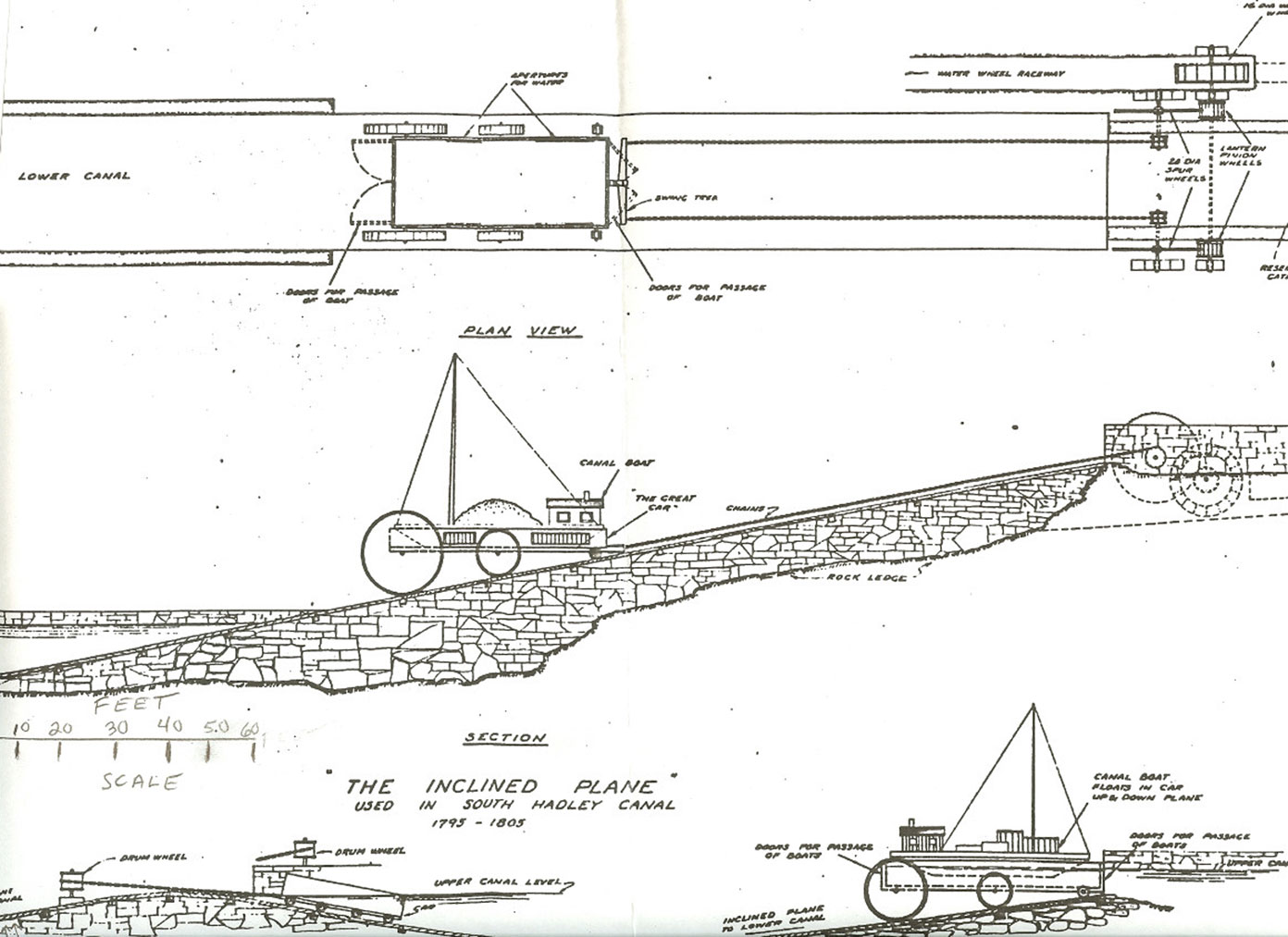
The above photo is courtesy of the South Hadley Historical Society.

A “Reign of Terror” in Old Hadley

The year was 1675, almost eighty years before the French and Indian War and exactly a hundred years before the American Revolutionary War (29). “King Philip’s War,” or Metacomb’s Rebellion, a conflict between several Native Americans tribes was led by Metacomb, or “King Philip,” and the more recently arrived New England settlers, supported by the Pequot, Mohegan and Niantic tribes.

The supposed intervention of General Goffe in the previous post—as an Angel of God, saving helpless inhabitants from an Indian attack—is debunked in Alice Morehouse Walker’s Historic Hadley: A Story of the Making of a Famous Massachusetts Town, published in 1906. She writes, “the story is based only upon a tradition which has no real foundation,” but nevertheless poignantly describes the fear of the town at the time:

“…the air was full of rumors of war, and the panic-stricken inhabitants lived in constant expectation of slaughter and destruction. We can hardly realize the terror of those days in the unprotected hamlet, when the forests all about seemed filled with the shadows of unseen foes. Again and again, alarmed by some unknown cause, the cattle and horses came rushing into the clearing in a wild stampede, and the women and children hid in the darkest corners of their homes, and held their breaths for fear” (27).

Extrapolating from Walker’s words, losses from the conflict were heavy on both sides. She writes of a Major Pynchon receiving a “warning that five hundred of King Philip’s men were in readiness to fall upon Springfield” but before they could arrive, they saw “afar off the sky red with the flames of thirty-two blazing houses, only thirteen remaining unharmed” (28-29). The New England troops retaliated: “an old squaw was torn to pieces by dogs, and other cruel acts unworthy of a civilized people were committed” (29).

By the end of the war, its “demoralizing” effect had generated much concern and led to increased policing of Hadley town members (36). Certain inhabitants were fined for small transgressions—one had a pack of cards, two others traveled the night before the Sabbath (36-37). A more serious incident involved a young boy, who, after his horse shied from a dog, fell to his death. The grieved parents, Mr. and Mrs. Nash, brought a suit against the owners of the dog, Mr. and Mrs. Goodwin, and the court delivered a verdict which seems incredible now:

“It doth not appeare yt Mr. Goodwin or Mrs. Goodwin had sufficient notice given them of their dog’s curstness or any warning to restrayne their dog, and therefore the Corte doth acquit them, and accounteth Goodman Nash or his wife blameworthy in not having a more strict watch over their son, but letting him goe to fetch ye mare from pasture with such mean tackling” (37).

Following King Philip’s death in 1676, the war concluded, and life presumably settled down once more in Hadley and the surrounding area.

Regicide Jurists in Hadley, MA

In the days when overcoats on sale cost $12.95 and “Laxative Bromo Quinine” was sold 25 cents a box and cured “a cold in one day, grip in 2 days,” William E. Curtis, a special correspondent of the Chicago Record-Herald, wrote an article regarding the fate of two jurists who condemned King Charles I of England to die.

The two jurists in question–“General Wiliam Goffe, son-in-law of Oliver Cromwell, and General Edward Whalley, a cousin of the Protector”–had been members of the High Court of Justice, which sentenced King Charles I. After the Restoration, the two fled to the Colonies to escape “keen” royal vengeance. Originally, they settled in Cambridge, MA, then “New Haven, Hartford, and several other places” in efforts to “escape the hangman” who “searched for [them] in every corner of the world except the village of Old Hadley.” It was in this town where, in the winter of 1664, the two jurists “arrived secretly and in disguise.” Both Goff and Whalley stayed with a Reverend John Russell, who was the pastor of the Congregational Church in Hadley, until their deaths in 1679 and 1676, respectively.

According to journalist Curtis, the regicides had to live “in concealment in the parsonage and were not permitted to leave its shelter during the daytime for fear of spies.” The two had been pursued from England to the Colonies and actually journeyed on foot through the Holyoke Mountains “until their pursuers were thrown off the scent and returned to New Haven to try and pick it up again.” During their years in Hadley, Curtis imagined that the lives of the jurists were “lonesome and irksome, notwithstanding the cordial hospitality of Parson Russell and the neighbors who were in his confidence.” The two jurists stayed in a secret compartment in the parsonage attic, only accessible through a trap door. In case of an emergency, the ladder leading to the compartment could be “taken away and concealed,” leaving no evidence “to indicate the existence of a human being above.” A “closet in the cellar… fully stocked with provisions” was a fall-back “retreat for an indefinite time.”

The last incident of note in the history of the regicides in Hadley is best described in Curtis’ own words:

“In September 1675, while the citizens of Hadley were attending a long fast day service, the church was surrounded by a band of Indians. Before the savages could carry out their horrible intention of setting fire to the building, the congregation was warned by a stranger of venerable and commanding appearance wearing old-fashioned English garments and carrying a sword. He assumed command without question and conducted the defense in a military manner, as if he was familiar with warfare, and, under his leadership, the savages were repelled and many of them slaughtered. In the confusion of identifying the bodies of the dead at the close of the battle he suddenly disappeared and was never seen again. The inhabitants of Hadley could not explain the phenomenon except as divine interposition and called their rescuer an angel from God.”

History from South Hadley

As part of an overall mission to integrate library materials into the wider world, to make available that which was once inaccessible and lost, to educate and enlighten the public about the history of the library and the town of South Hadley, the Gaylord Memorial Library has started to blog about archival materials of interest. Enjoy the postings, and if a particular item catches your interest, see the Bibliography page and/or feel free to visit our archives.