An Artist and an Architect

William H. Gaylord

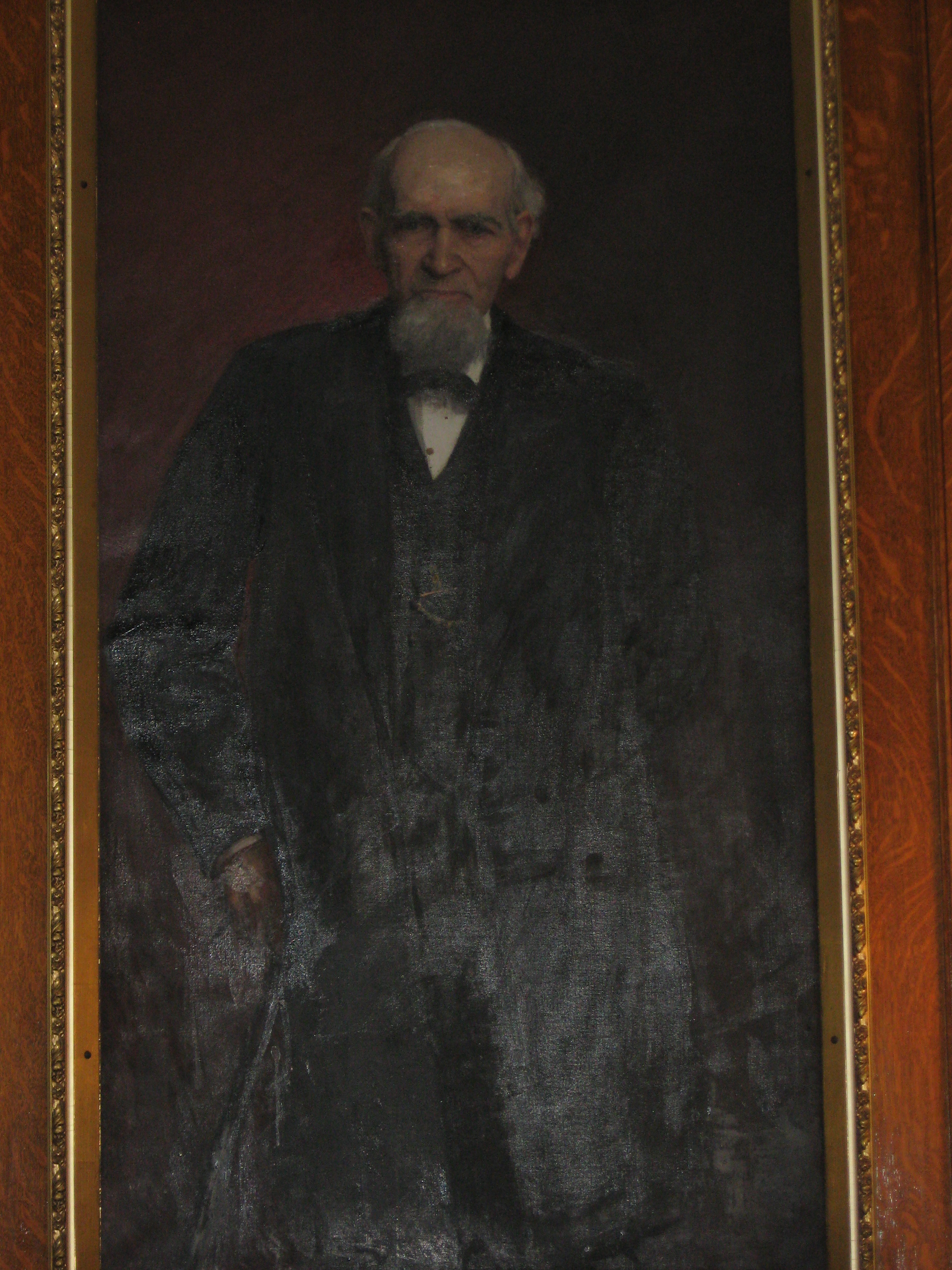
As the artist of paintings above and below, Katherine Gilbert Abbot was born in 1867, in Zanesville, Ohio (home to the only Y-shaped bridge in the United States). Through her mother, Maria Louisa Gilbert, Abbot could trace her lineage back to the American Revolution; in fact, her sister, Miss Maria Elizabeth Abbot, was a 1906 member of the Daughters of the American Revolution (Coltrane, 1921: 28). Both were great-great-granddaughters of Colonel Henry Campion, who transported cattle to the American Continental Army and prevented General George Washington and his army from starving at Valley Forge (Taglianetti, 1976).

Abbot studied both at the Art Students League in New York and in Paris (Haverstock et al, 2000: 3). According to the catalogue from the Paris Exposition of 1900, her teachers at the Art Students League were H. Siddons Mowbray, a noted muralist, and William Merritt Chase, an American Impressionist whose pupils later included Georgia O’Keefe (Paris 1900: 194). Through cross-referencing, it is possible to approximate her time at the Art Students League. Because Chase taught at the Art Students League from 1878 to 1896 and again from 1907 to 1911, and Abbot was taught by him prior to the 1900 Exposition, she must have studied between the ages of 11 (presumably too young) and 29. However, she did an exhibition at the Paris Salon in 1894, which suggests that she arrived in Paris prior to that, so at the latest, she was 27 when she left New York (Petteys, 1985).

Once in Paris, she worked under Léon Merson, Henry Jules Jean Geoffrey, and Paul Louis Delance. In the catalogues of Paris Salon exhibitions prior to 1900, she had two entries. For the first, the previously mentioned 1894 exhibition, she displayed a “Portrait de M.L….” and she lived in Chez Mlle Fixes, rue Le Verrier, 13 (Fink, 1990: 315). In a year’s time, she changed her address, moving to rue de Chevreuse, and she was enrolled in the Salons of the Société Nationale des Beaux-Arts. She had two paintings for this exhibition—“Portrait de Mlle Y…” and “Anxiété”—and the latter was also her entry for the 1900 Paris Exposition, for which she was awarded a bronze medal (Fink, 1990: 315; Paris 1900: 194). It is uncertain when she moved back to the States, but in 1901, she exhibited at the Pan-American Expo in Buffalo, New York, earning an honorable mention (Petteys, 1985).

It is equally difficult to determine when and where Katherine Abbot met Allen H. Cox, the architect for the Gaylord Memorial Library. Construction for the Library began around 1902, and as the already brief literature on Abbot disappears entirely after 1901, it is likely that the two met around this time. However, as they both studied in Paris, they may have been aware of each other prior to that. Abbot would have been around 34 years old, an old maid for that time. It is certain that she and Cox were seeing each other while they worked on the portraits of the Gaylords and the library architecture, respectively. The two were wed in 1904, the same year the library was completed and William and Betsy Gaylord passed away, and the couple was living in Boston by at least 1905 (Haverstock et al, 2000: 3).

Abbot’s husband, Allen H. Cox, was born in 1873, here in South Hadley, and attended Holyoke schools (Clancy, 1979). Sometime prior to his marriage, Cox formed an architectural firm with William E. Putnam, Jr. Though they attended different schools—Cox at MIT, Putnam at Harvard (Class of 1896)—they may have met at the École des Beaux-Arts in Paris where they both studied (Clancy, 1979; Association of Class Secretaries). In 1902, Putnam returned to the States to win, with Cox, the competition to redesign the Boston Athenaeum (Association of Class Secretaries, 1902: 321-322). Plans for this new building must have fallen through, since I find no credit attached to Putnam and Cox for the Boston Athenaeum. The only further reference to any planning at the time is an article from the New York Times in 1901.

Based in Boston, Putnam and Cox did not lack for clients, and their particular specialty appears to have been libraries. In addition to Gaylord Memorial Library, commissions over the years included:

– 1897: South Hadley Main Library

– 1910: 2 houses on Garfield Street in Watertown, MA

– 1915-1922: a series of fraternity houses at Amherst College, Amherst, MA

– 1926: Lord Jeffrey Inn, Amherst, MA

– 1926-28: Jones Library, Amherst, MA

– 1930: Kirstein Business Branch, Boston, MA

Through Putnam, the firm had close ties to Harvard. Fellow graduate, Nathaniel Saltonstall (Class of 1928), joined as a partner until 1945 (Cape Cod Modern House Trust). A presumable descendent of a prominent New England family, one of whose members resigned from the court of the Salem Witch Trials, Saltonstall helped to found the Institute of Contemporary Art (ICA) in Boston (Cape Cod Modern House Trust). Another graduate, Alanson Hall Sturgis (Class 1914), also started his career at Putnam and Cox (Harvard College Class, 1921: 256). Both Saltonstall and Sturgis served in World War II; Saltonstall as a lieutenant in the Army Air Corp, Camouflage Division, and Sturgis primarily as an Ensign in the Naval Reserve Flying Corps (Cape Cod Modern House Trust; Harvard College Class, 1921: 256).
After the death of Cox in 1944 (age 71), Saltonstall left Putnam & Cox. Abbot had passed away fifteen years prior, back 1929, at the age of 62. Currently her bronze medal painting, “Anxiété” is “unlocated,” and despite various efforts, I was unable to find any other of her paintings (Paris 1900: 194). Her fame is limited to terse entries in dictionaries, but considering her education, the company she enjoyed, her exhibitions, and of course, her two paintings that are still displayed in the Library veranda, Katherine Abbot would have been considered–is still considered–a successful painter.

Betsey S. Gaylord

A Note on Love

While researching “This Week in Time” and perusing Deacon Edward Chapin’s diary, I stumbled across this note, about two weeks too late for Valentine’s Day, but far too interesting to resist:

“(A Note) – August 18, 1749

Dr. Watt’s Receipt to Expel Love:

Take 28 (pounds) of other folks’ bought experience and 2 1/2 pounds sweet contentment and 1 pound 12 ounces of due consideration and bruise them together in a mortar of mortification. You spread ’em (them) on a leaf of patience & apply to the soft places of the head, then take a spoonful & 1/2 of Resolution each morning & learning not to keep much bad company by a right use and improvement of these things, it will well cure or wholly carry off that fatal heart killing Disease called Love Sickness.”

My jaw dropped. Every week, I scramble to find at least one diary entry that is not primarily concerned with the weather or natural phenomenon. Granted, the weather back in the mid-1700s is fascinating, especially in comparison to the weather today, and it strongly influenced the lives of farmers and frontiersman, but one can only read so much about snow and blackbirds. On those occasions when Chapin branches out, his descriptions are terse, a la “21 Jeudy [1754] – Was married William to Martha Chapin” and “This evening was drowned in Agawam, John King of Springfield. On Monday last Robbins, the butcher of Boston, Hanged himself (Memento Mori).” Based on these entries, I assumed that Deacon Edward Chapin was unromantic, at least in today’s sense of the word, either due to inclination or situation, or both.

Consequently, the above entry was thrilling. Chapin cared about love? And cared enough to jot down a note in his diary? I immediately checked his biography, as provided by Reverend Asa W. Mellinger at the beginning of the book. Mellinger proved as terse as Chapin, describing the Deacon as “active in town affairs” and supportive of the American Revolution (1976: II). He did not mention a marriage. The genealogy of South Hadley families provided a little more information—Deacon Edward Chapin was born February 16, 1724, married Eunice Colton of Longmeadow on July 6th, 1752, and died Janaury 6, 1800. The two had eight children and, interestingly, had a penchant for classical names, naming a daughter Lucretia and a son Lucius. All of this was fascinating, but not the information I wanted—how did a “farmer and frontiersman” really feel about love in the 1740s and 1750s?

I returned to the diary. Prior to the entry on how to expel love, Chapin writes, “11 Lundy – This day, Brother Aaron and his consort arrived at Chickapee.” Perhaps he includes the Dr. Watt’s receipt because he is jealous of his brother’s marriage and wishes to get married himself. Then again, perhaps that is too melodramatic. Five months later, he states, “I rue the last years. Alas, me thinks I am much inclined to be bitter more & so is the thought.” Could that be a sign of disappointed love affair? Maybe the girl proved unsuitable or unwilling. Two years later, in July 1751, he could still be thinking on it, based on the following: “Mr. John Hitchcock expired, aged 82 or 3, Having lived with His Concert 59 years and about 9 months. O! Strange! And now through Grace as willing to part as ever to be together for the declared (?)”. But is he expressing astonishment over the fact that the marriage lasted so long, or that the two parties lived so long? Sadly, it was probably the former, since three months later, he says the same thing—“O! Strange!!”—about have five people over for breakfast and five over for dinner.

In May 1752, the diary mentions that, “28 Jeudy – I fear that urged the affair — to be accomplished”—which could possibly refer to his marriage. The June 17th trip to Longmeadow would have certainly been in preparation for the upcoming nuptials. Unfortunately, Chapin’s entry on his wedding day is sober:

“6 Lundy [1752] This day I hear of Worthington had a letter last Saturday from Jonathon Dwight of Boston, informing that Brother Aaron died of the Small Pox, May 17, on Ramsforth Island or Randford Island. Having (as before noted) had confirmation of the heavy tidings of my dear Brother’s death, the scheme of accomplishing the wedding is altered…Our Nuptials Celebrated late this evening.

Blessed be my good God for all His goodness Who has not forgot to be Gracious but knows to fill the place which the removal of great mercies has left empty; with greater. May His Dealings be Sanctified.”

Even with my attempts to find references to a hidden love, I cannot help concluding that the empty place refers to the loss of his brother, rather than an earlier love. I thus end this post with a sense of frustration. Any extrapolations from the diary are, at best, tenuously supported, and at worst, a figment of my imagination. In a generation familiar with Facebook, where photos of couples and relationship statuses make personal matters readily available, Deacon Edward Chapin serves a reminder that discovering intimate details in the past is far more complicated.

Fun on the Ferry

Continuing the series of articles on the Connecticut River, for those individuals without boats—and hence no way to take the canal—the main means of crossing the river was by ferry. According to an article in a 1935 edition of the Holyoke Daily Transcript and Telegram, traveling by this method was time-consuming and frequently inconvenient. Travelers and livestock alike went on the ferry, and sometimes “a frisky horse or cow…would satisfy its curiosity by falling into the water. The ferry would then be halted, regardless of the impatience of the busy traveler, while the ferryman rescued the surprised animal.” Tales of inadvertent swims were not restricted to animals either. In 1935, “old-timers” were still laughing when they told “of some proud young dandy falling overboard and shak[ing] their heads and sigh[ing], ‘Those were the days!’ when questioned about their experiences in crossing the Connecticut.” In addition to clumsy passengers, ferrymen also needed to avoid logs (which were floated down river), and the current was a persistent threat.

According to the article, the first ferry on the Connecticut River began running between Northampton and Hockanum in 1658, over a hundred years before the inclined plane canal was constructed in South Hadley. Numerous ferries sprang up afterward, and one of these, run by a “Job Alvord from South Hadley” apparently “reaped profits from tremendous business” until canal arrived. Nonetheless, as mentioned in the previous paragraph, those without boats maintained the demand for a ferry service. In fact, Smith’s Ferry, which ran from South Hadley to Northampton (the equivalent of the PVTA back then), did not establish its dominance until well past the lifespan of the canal.

Smith’s Ferry, which is featured in both the photo above and the photo below, was a well-off business venture. Transporting the necessary supplies for Mount Holyoke, relied on the ferry, “so the ferryman could count on considerable profit.” Indeed, Mary Lyon herself “crossed the ferry many times and the students made frequent trips across on Mountain Day or other holidays.” The rates were “13 cents for a single horse and carriage, 25 cents for a double team, 25 cents for coal team, five cents for a foot passenger and three cents a head for cattle.”

As with the canal, ferries were replaced by another form of transportation, namely the construction of the South Hadley Falls Bridge. The article thus concludes on a sad and nostalgic note: “Undoubtedly such advancements are more efficient and sure but they lack the picturesque and friendly quality of earlier transportation methods…Little trace remains of [those ferrymen], yet they will live in histories of the Connecticut Valley as part of these early, colorful days in which Western Massachusetts had its beginnings.”

“The Proprietors of the Locks and Canals on Connecticut River”

The Inclined Plane Canal of South Hadley seems to be in the air at the moment. Last Thursday, the Library began offering plaques for sale which feature the canal and the words “Welcome to South Hadley.” (For those interested, the painted commemorative plaques are available for $20, $2 of which directly benefits Gaylord Memorial Library.) Indubitably inspired by the plaque, a patron also brought up the canal in a conversation last Friday. Finally, this Tuesday, I heard it mentioned in my biology class, in tangential connection to geology, Darwin, and monetary profit. As a non-resident of South Hadley and firmly cloistered in my studies, I had not the slightest idea of what an “inclined plane canal” entailed, much less what one was doing in South Hadley.

According to Alice Morehouse Walker, whose knowledge of Hadley truly is amazing, the inclined plane canal began construction in 1792 (1906: 109). The impetus for such an endeavor was a company, “The Proprietors of the Locks and Canals on the Connecticut River.” At the time, the Connecticut River facilitated transportation considerably (more articles to follow regarding the River). As Walker writes, “this natural waterway formed a connecting link between the isolated villages by means of which they were kept in touch with each other and in communication with the outside world” (1906: 109). Lumber was rafted down river, in addition to “farm produce, shingles, ash plank, furs and fish” (Walker, 1906: 107). Once downstream, the rafts and boats had to be poled up stream. “Poling was the hardest work known and caused much lameness and blistering of the skin in front of the shoulder, for which a frequent application of rum was a remedy” (Walker, 1906: 108). Furthermore, in South Hadley, “The Connecticut River had a fall of about fifty-three feet in the two and one half miles of rapids” (Taugher, 5). An inclined plane canal, in this context, is justifiable.

Building the canal was a daunting task, and back then, no canal had ever been built in the United States. “Gun powder was the only explosive known and drilling was done by the hands of man” (Walker, 1906: 109). The channel for the canal went through solid rock for two and a half miles and at its narrowest, was 20 feet wide (Walker, 1906: 109; Taugher, 4-5). Dutch enterprisers, who would certainly profit from increased commerce as well as the anticipated tolls, supplied the majority of the funding, but money was apparently scarce at the time (Taugher, 4). In addition, because of the drilling, water flooded nearby fields and meadows, “produced fever and ague, and indignant citizens clamored for the removal of the time [while] Those interested in the fisheries demanded a fishway that the shad might go up the river to their spawning shoals” (Walker, 1906: 109).

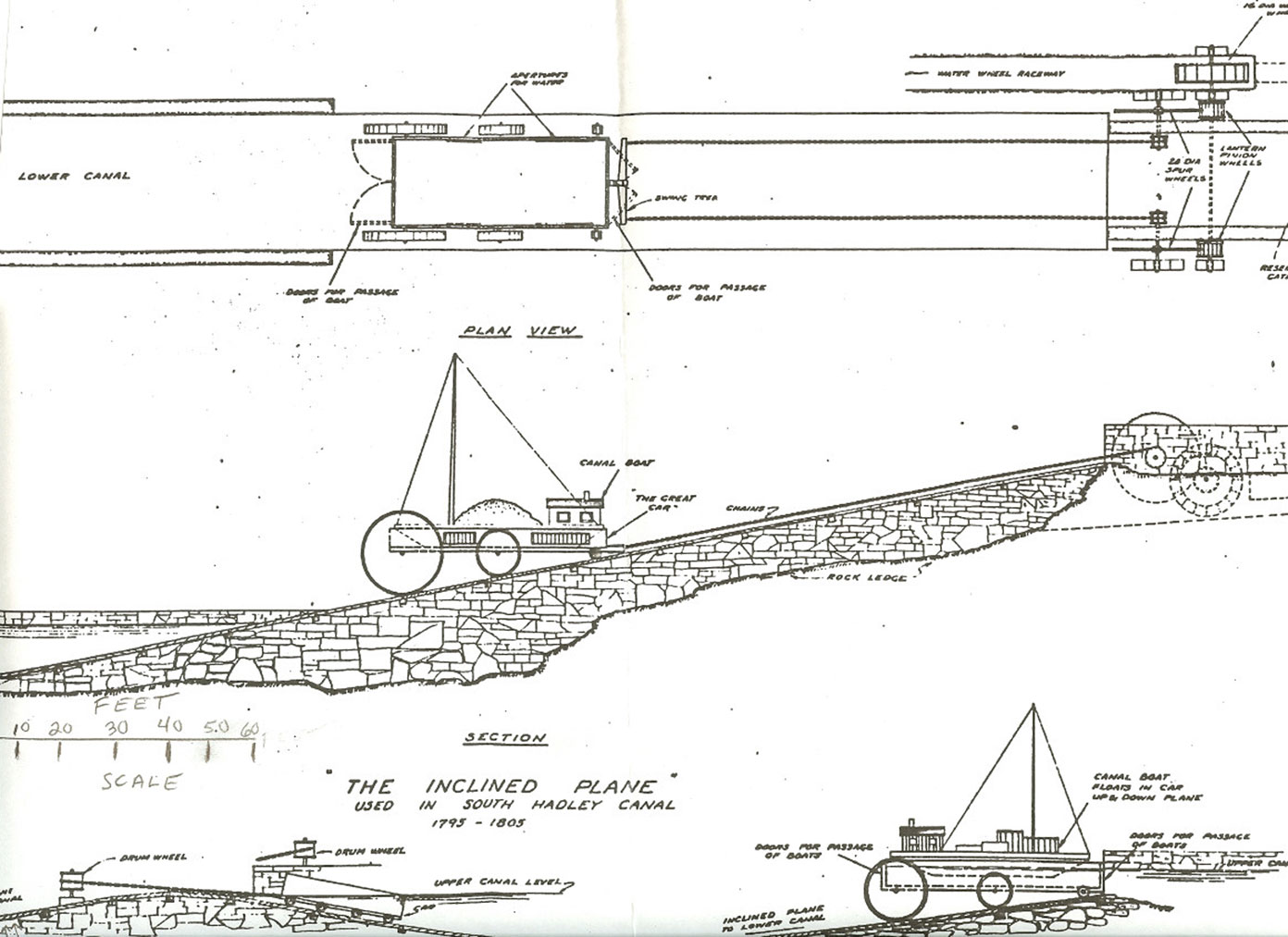
Furthermore, the mechanics of an inclined plane canal vary, most in terms of power sources. For example, “In the inclined plane proposed by Fulton, the boats, being placed on carriages while in the water, were drawn over a ridge having a slope in both directions, by a force derived from a vessel of water descending in a vertical well. A similar double plane was used by Kitchell on the Morris Canal, but the power was derived from a water-wheel” (Renwick, 1840: 177). “The Proprietors of the Locks and Canals on the Connecticut River” decided to opt for this second power source: “The wheels [of the canal] are turned by a large trundle wheel, fixed on each end of the shaft of water of sixteen feet in diameter, and this water wheel is put in motion by water supplied by a small reservoir” (Morse, as quoted in Taugher, 6-7). For every pound acting on the water wheel, 24 pounds could be lifted by the canal (Taugher, 7). A carriage was thus moved up or down the incline, which was stone enhanced with wooden planks (Taugher, 5). As the first of its kind, the canal opened in January 1795 to much appreciation: “Even the cold of the early winter, the people of the region surrounding the canal had a holiday and gathered in large numbers to admire the great work done and to ride and down the inclined plane in the grand carriage” (Taugher, 5). Even despite high running costs, a false criminal accusation, and much repair and maintenance work, the canal continued to assist boats up and down the Connecticut River throughout the early 1800s. Unfortunately, in 1848, other methods of transportation took precedence, and the canal closed for transportation.

The above photo is courtesy of the South Hadley Historical Society.

A “Reign of Terror” in Old Hadley

The year was 1675, almost eighty years before the French and Indian War and exactly a hundred years before the American Revolutionary War (29). “King Philip’s War,” or Metacomb’s Rebellion, a conflict between several Native Americans tribes was led by Metacomb, or “King Philip,” and the more recently arrived New England settlers, supported by the Pequot, Mohegan and Niantic tribes.

The supposed intervention of General Goffe in the previous post—as an Angel of God, saving helpless inhabitants from an Indian attack—is debunked in Alice Morehouse Walker’s Historic Hadley: A Story of the Making of a Famous Massachusetts Town, published in 1906. She writes, “the story is based only upon a tradition which has no real foundation,” but nevertheless poignantly describes the fear of the town at the time:

“…the air was full of rumors of war, and the panic-stricken inhabitants lived in constant expectation of slaughter and destruction. We can hardly realize the terror of those days in the unprotected hamlet, when the forests all about seemed filled with the shadows of unseen foes. Again and again, alarmed by some unknown cause, the cattle and horses came rushing into the clearing in a wild stampede, and the women and children hid in the darkest corners of their homes, and held their breaths for fear” (27).

Extrapolating from Walker’s words, losses from the conflict were heavy on both sides. She writes of a Major Pynchon receiving a “warning that five hundred of King Philip’s men were in readiness to fall upon Springfield” but before they could arrive, they saw “afar off the sky red with the flames of thirty-two blazing houses, only thirteen remaining unharmed” (28-29). The New England troops retaliated: “an old squaw was torn to pieces by dogs, and other cruel acts unworthy of a civilized people were committed” (29).

By the end of the war, its “demoralizing” effect had generated much concern and led to increased policing of Hadley town members (36). Certain inhabitants were fined for small transgressions—one had a pack of cards, two others traveled the night before the Sabbath (36-37). A more serious incident involved a young boy, who, after his horse shied from a dog, fell to his death. The grieved parents, Mr. and Mrs. Nash, brought a suit against the owners of the dog, Mr. and Mrs. Goodwin, and the court delivered a verdict which seems incredible now:

“It doth not appeare yt Mr. Goodwin or Mrs. Goodwin had sufficient notice given them of their dog’s curstness or any warning to restrayne their dog, and therefore the Corte doth acquit them, and accounteth Goodman Nash or his wife blameworthy in not having a more strict watch over their son, but letting him goe to fetch ye mare from pasture with such mean tackling” (37).

Following King Philip’s death in 1676, the war concluded, and life presumably settled down once more in Hadley and the surrounding area.